

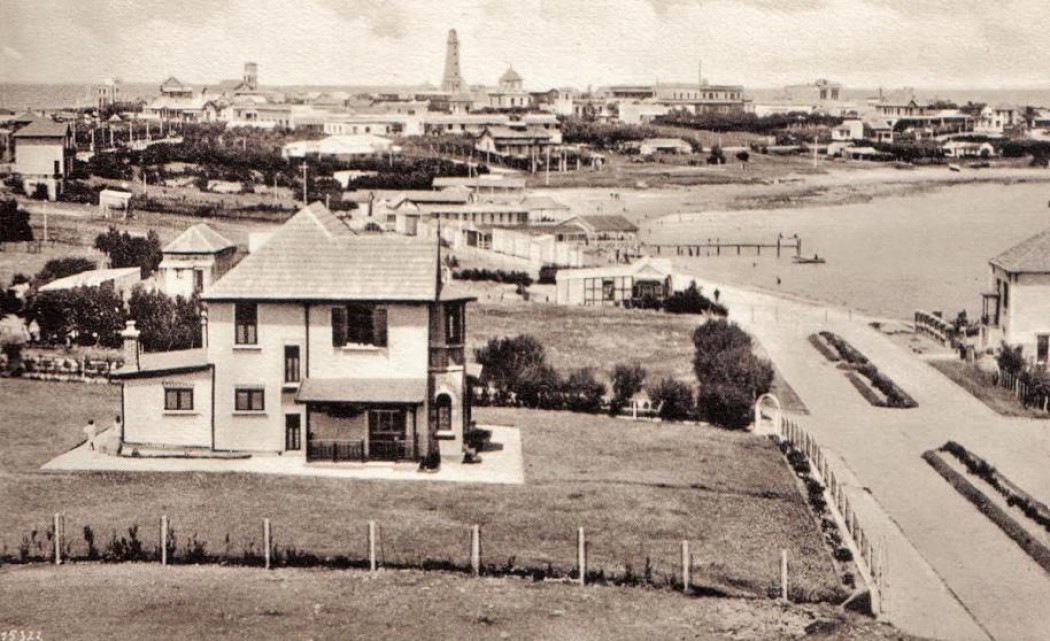
Punta del Este celebrated its anniversary, between minimal stories and dreams of greatness. Punta del Este. Photo: Diego Fischer Archive
Punta del Este turned 110 years old and the date surprises it in its usual state of permanent change. In this century and a decade, the old town of Ituzaingó went from being a peninsula where you could watch the sunrise and sunset from the same point, without moving, just letting the hours pass (and inhabited in summer by two hundred Argentine and Uruguayan families) to becoming an internationally renowned seaside resort, where its beaches burst with tourists from all over the world in January and February. The gentleness of a town where everyone knew each other has been lost, but not the magic. Long before it became our main seaside resort, it was a place of low and spaced houses. Photo: Diego Fischer Archive
Parallel stories.
Luis Sader is the third generation of a family whose history runs parallel to that of Punta del Este. His grandfather Abdón, his father Emilio, and his uncle César arrived in Maldonado in 1909. They came from Líbano, where they owned a natural silk factory. They settled in Pan de Azúcar. Shortly after, Abdón climbed the Sierra de la Ballena mountain range on horseback and from there gazed at Punta del Este, to whose port a Carrera steamer from Buenos Aires was heading. "That's where the future lies," he thought. Months later, the entire family settled on the Peninsula, and in the summer of 1911, on 9th and 10th Streets, they opened Casa Sader, the most important general store in Punta del Este, which operated until 1970.
Don Luis, now 83, told El País that life on the Peninsula during his childhood was like that of any small town. The difference was that Argentine and—to a lesser extent—Uruguayan tourists arrived in the summer. Work increased. “A public came that was accustomed to consuming top-quality products. They were very refined, wealthy, and cultured people who were used to living the high life in Paris,” he emphasized.
What attracted the handful of families who lived in the mansions of Recoleta and Barrio Norte? The simple, peaceful life where nature ruled and a friendly, polite town that welcomed them. These families did not want people to find out that so close to Buenos Aires there was a paradise in its purest, almost wild state. There was no electricity or water. Only a calm sea and another rough one, and the wind that blew freely. The buildings were precarious, many of them made of wood, imported from the Nordic countries. Almost all of them faced the old Mansa beach, which disappeared several decades ago due to the expansion of the port and the construction of the promenade. It was not until the beginning of 1930 that the chalets with red tile roofs began to be built.
With the arrival of the Argentines, starting in 1910, hotels such as the British House, the Biarritz and La Cigale also began to be built, headed by Madame Pitot, a Frenchwoman who was a cook for the former Argentine president Carlos Pellegrini (1890-1892) and who marked a before and after in the hotel and high-level gastronomy industry in Punta del Este.
The public that arrived was so demanding that Don Abdón Sader had to open an adjoining premises to set up a bookstore where mainly books in French by French authors were sold. He had to adapt to what the people were asking for. These people gave their imprint to Punta del Este.
At that time, Punta del Este was reached either by boat or by coach of Estanislao Tassano's Compañía Comercial del Este. It is said that the foreman would leave his passengers at the door of their houses, after a trip that took more than 8 hours from Montevideo. In 1910, the railway arrived in Maldonado. Two decades later, the tracks would be extended to the Peninsula. The Míguez and Nogaró Hotels then emerged. The Burmester family in Madame Barrere's beach hut, a photograph taken in the summer of 1920. Photo: Diego Fischer Archive
Seafarers.
Betty Clavijo de Silveira now owns two boats that travel between the Peninsula and Gorriti Island. To trace her roots in Punta del Este, we must go back to 1853, when her great-grandfather, Gervasio Enrique, landed his small fishing boat in the port of La Candelaria. He was originally from Entre Ríos. He settled on the Peninsula and gave rise to a family of fishermen and seafarers, of which Betty is the fourth generation. At 85, this woman continues to run the company Consorcio Gorriti, which she shares with two other partners. She is in love with Punta del Este, and it shows. Although she clarifies that she feels "nostalgic for the beach resort of her childhood." Her life has always been linked to the sea, and the legacy is evident: her three sons are ship captains, but of her eight grandchildren, only one became a sailor.
She grew up in the same Punta del Este of Sader, where its permanent inhabitants prepared themselves to receive and serve in the best way possible the tourists who arrived in December and stayed until March. A lover of the history of her area and an active participant in literary workshops, Betty has just written a book about the stories of the anonymous beings she met in her childhood and adolescence in Punta del Este.
In love with the sunsets of the Peninsula, but also with the warm nights when the moon peeks out over the Brava, she confessed to El País that it was and is difficult for her to get used to the changes in the resort. An image of when the streets of Punta del Este barely had any cars. At that time, bicycles were an ideal vehicle for walking and getting around. Photo: Diego Fischer Archive
The properties that are maintained.
Betty Clavijo now owns two boats that travel between the Peninsula and Gorriti Island. She considers herself fortunate, having lived in the resort for so many decades, although she admits to feeling nostalgic when she recalls her youth: "The changes were so rapid..." she commented. She added: "At least the old Punta del Este remains, with its houses." Indeed, some of the buildings in the images above can be identified today in Punta del Este, in some cases hidden among modern buildings. Our main resort turns 110 today, and the date surprises her in its usual state of constant change. For many, it is the main tourist city in South America.
Stories beyond a summer love.SUMMER.
Maureen O'Farrell de Murphy is Argentine. She traveled with her parents for the first time to Punta del Este in the summer of 1945, when Juan Domingo Perón came to power. Her previous summers were spent in Mar del Plata. She was 17 years old and remembered that the whole family fell in love with the resort. At the end of the season they bought Casablanca, opposite the Emir beach.
“The freedom we had was wonderful; we rode our bikes everywhere. We used to go to La Barra on the path that was there back then,” he said, recalling that the second summer they came, his father had to hire a sailor to rescue people who came on excursions and jumped into the sea, even though they didn't know how to swim.
Maureen has just turned 90 and since 1945, she has never missed a single season in Punta del Este. She has four daughters, twenty-one grandchildren and fifty-three great-grandchildren. All of them have come and continue to come to Casablanca. When October begins, she already starts thinking about her holidays. Her love for Punta del Este was not a summer love. It was and is unconditional.
Source: el pais.com.uy
