

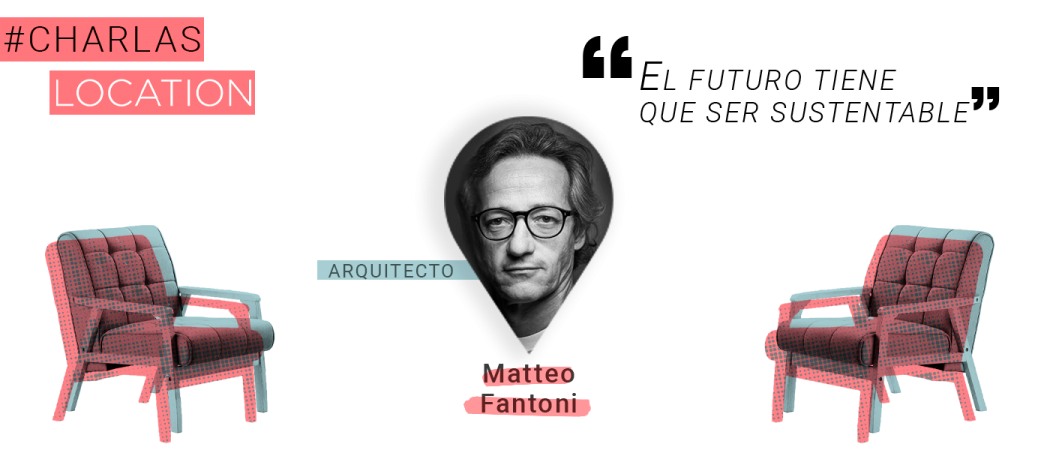
Charlas Location is a series of live interviews that we conduct on our Instagram account.
On October 23rd, we conducted an exclusive interview with Matteo Fantoni about the development and vision for achieving a more sustainable system. These were the main points of the conversation:
Life in Uruguay
“I chose to stay here in March, at the height of the pandemic in Europe. It is not so easy to change a line of work, a line of life, it is quite interesting what happened to me as a person. I think it is an opportunity for me and I think it can also be an opportunity for everyone. In Europe we have had July, August and September, a rather disillusioned attitude on the part of the people.”
“I stayed here because Uruguay shows an attitude and an infrastructural dimension, also in the number of people who live there, that is very interesting. It is a small place, but not so small, because it is half the size of Italy, which has more than 60 million inhabitants, when Uruguay has 3 and a half million. This is what I always had in mind, because in some places you can live better and without risks, having other problems, obviously, economic, development, work, because Uruguay also has its issues. But other places in Europe, a city like Milan, has other problems. And the pandemic showed that the issue of the virus is a very complicated issue in dense places like Milan, London, Paris, Berlin, New York. On the other hand, in places like Punta del Este, where obviously in winter there are very few people, the problem was much smaller. What do I mean by this? I am not interested in talking about data and numbers at the moment, but as an architect what I always think about is how to have a balanced attitude that can develop opportunities for work, education and health. And what are the measures for developing master plans, territories, and systems?
Balance with the environment
“The coronavirus, like any natural event, comes and no one knows when. And why do I talk about a natural event? For me, the issue of the environment is fundamental, it is proven and there are papers that have been written about how we have to try to keep the environment under control and not in a senseless development. All the issues we have had with rains, droughts, tsunamis, fires, are a consequence of a development of many years where environmental balance was left aside.”
“We cannot think that we can continue with the same attitude towards life and management of the place, which is not ours, which is for a future generation. We are here for a very short time, but the next generation, the children who are now nine years old or who have not yet been born, will use the place as guests. So it is essential to maintain a balance between a world of consumerism and a world that respects the environment.”
Sustainable architecture
“Architects are not going to change the world. We architects are available to answer questions about the development of places, about how to think about the city of the future. We are there to give our vision. The future has to be sustainable.”
“Infrastructure development projects, such as the port of Montevideo, are very important because in this time of unemployment, we need to advance the development of the place, and places are developed with connections. Uruguay has, for example, a very important tourist coast, a very strong source in the west on the Uruguay River due to the paper industry, and a north with a lot of forestation. Forestation was something that was pushed very strongly in recent years, we have more than 6 million plants standing.”
“In Europe we have the problem of cities with a lot of pollution, and from this point of view, it is being thought that all buildings need to be built with a zero carbon footprint. So the management of the construction and also the maintenance and life of the building does not have to produce carbon. It is obvious that a good part of the project is not only the maintenance, but how the building is made. Uruguay can have this, a similar development, using the raw material that is in the north, processing the material and creating a very interesting added value. Wood leaves Uruguay today with very little added value. So, what does this generate? Sociality, growth, workplaces, education, everything that is important in the development of a place.”
“A prefab building takes half the construction time of a normal building and produces half the carbon. I am working with some English colleagues who just won an important competition in Sydney with a tower of more than 40 floors made of wood, steel and cement. The creativity of architects is very important; for a wooden building we don’t just need to think of a small single-family house. There are buildings of 5, 10 floors, a lot can be done. What is interesting here is that in the future I think these prefabricated elements can also be handled by robots, which would make the construction itself much safer for the workers. And people will not lose their jobs, because in the end there will always be a need for labor that has a little more advanced professional development and also creativity to achieve interesting solutions in construction.”
“I believe a lot in technology, but I also believe in the development of sustainable projects in themselves. A building has to aim to use the negative and positive conditions of the place, be it the wind, the water, the exposure to the sun. And all this is part of traditional architecture, because if you go to a field you immediately understand why an old peasant's house was oriented one way and not another. So the place is the matrix of the whole project. Then, obviously the technological part helps and manages the control of expenses, it manages the optimization of expenses. And you have to think very carefully about the insulation of a building, because if you have a more isolated building, it uses a lot of energy. And you can have the most interesting technology and it is useless. So it is a combination of three factors: the location, the construction using materials that allow for good insulation, and the technology.”
