

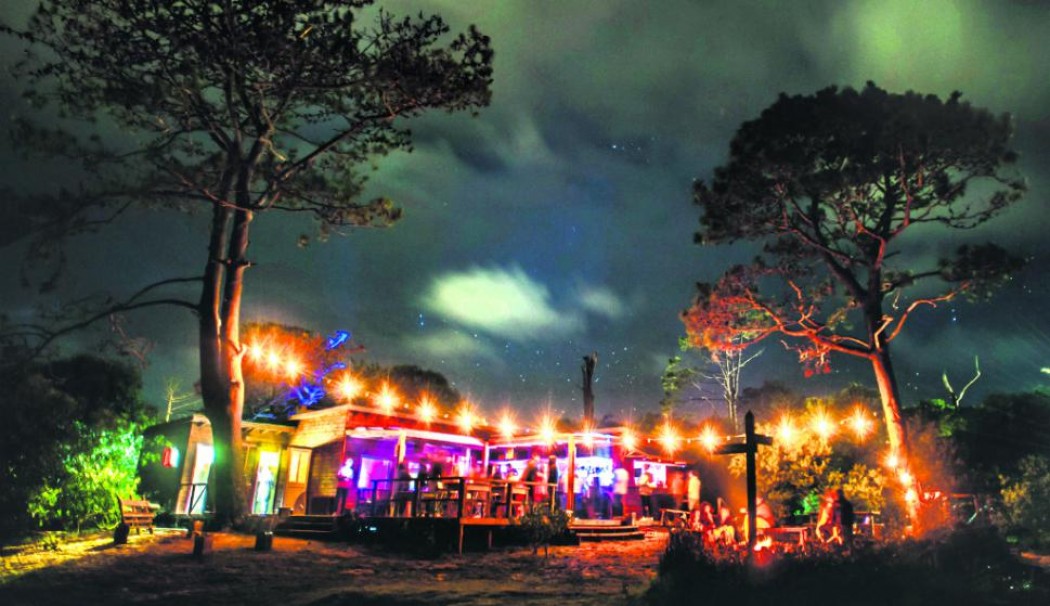
Located less than a kilometer from the center of José Ignacio, it is receiving more and more visitors. 25 years ago, Ignacio Ruibal decided to move to the La Juanita neighborhood in José Ignacio. He wanted a new place away from the old town of the resort, where his children could grow up in an environment of peace, tranquility and at the same time surrounded by nature.
At that time, there were no more than 10 families, of which 3 or 4 lived there year-round. There were few shops and they were all located on the same block, partly due to a regulation that established that La Juanita was an exclusively residential neighborhood, so it was forbidden to establish commercial premises outside the area delimited especially for that purpose.
Today the situation is completely different. The area has experienced exponential growth in recent years and this can be seen when walking around the 24 blocks that make up the neighborhood. Restaurants, bakeries, stores, decoration shops, hotels and inns, among other services, have been established and changed the appearance of the neighborhood.
Facing the road, "for sale" signs abound on the lots, and further inland, houses under construction are part of the landscape. Many, according to locals, were built in the winter so they could be ready for summer rentals, as demand during the summer season "hasn't stopped growing" for some time now.
Friendly population.
For the most part, the homes are in keeping with the style of the place: they are simple, far from the luxuries of Punta del Este or its older brother, José Ignacio.
Many were built from mud and others from containers, to have as little impact on the surroundings as possible. The streets are made of dirt and small businesses, many of which are established in the homes of the local inhabitants, abound in the neighbourhood.
According to Ruibal, La Juanita's growth is partly explained by the fact that it is located just one kilometer from the center of José Ignacio, it has a quiet beach - as well as a beautiful one - it is surrounded by nature and the price of the land is much more affordable than in the rest of the area.
“That made it an ideal option for young people, who were mostly the ones who brought businesses to the area and stayed to live here,” said Ruibal, a real estate agent.
A 450-square-meter plot of land in La Juanita costs between $36.000 and $225.000, depending on the area. In the area around the José Ignacio lighthouse, the price is between $1.000 and $4.000 per square meter.
In 2014, following in the footsteps of a friend, Fernando Gómez moved to La Juanita and opened his own business, Ferona, a restaurant where a different artist performs live every night.
The neighborhood was chosen primarily for "the view, the tranquility, and to get away from the noise, something that is impossible in the hustle and bustle of the city," said Gómez.
Currently, about 200 families live there year-round. “During the winter, it's very peaceful; we're all friends, and a very nice community has formed. In the summer, however, there are many job opportunities, and we like to welcome people from all over,” said Guillermina, Gómez's partner.
When they arrived, they say, there were few businesses. “Today there's one grocery store per block, and there are more and more restaurants—about eight—and they're all doing well. At least we're friends and don't see each other. That means we're busy, that we're doing a good job,” laughed the owner of Ferona.
This year, they noticed a greater presence of foreigners. "A lot of Europeans and also North Americans who come looking for something different," he said. A few days ago, attracted by the tranquility of the place, Argentine singer Charly García came to Ferona to perform and surprised the people who were there that night.
Young entrepreneurs.
Gastón Carrau, 36, is another of the young people who decided to start a business in the neighbourhood, attracted by the arrival of tourists that increases every season.
For a year, Carrau traveled the world staying in hostels. When he returned to Uruguay, he wanted to pursue a similar venture in his home country, but it turned out that in José Ignacio, the resort where he had worked for a time, "there wasn't a typical hostel crowd."
It then occurred to him to buy a piece of land in La Juanita and began, little by little, to build what is now “La Posadita,” with four rooms—more under construction—and capacity for 15 or 20 people.
"I started renting it out, and the business became increasingly important to my finances. This year, I quit my job to dedicate myself fully to this, since more and more people are coming," he said. He said he wasn't the only one who saw "that potential" in the resort.
"More than one has built houses and turned them into hostels or inns. They see that the resort is growing and that in the summer there's increasing demand for beds, whereas there wasn't much supply before," he said.
An exclusive, wild and bohemian neighborhood
La Juanita isn't just a wild and bohemian neighborhood, but it also has some luxurious touches. Major international investors set their sights on the area and built the sophisticated Bahía Vik complex (the same chain as Estancia Vik and Playa Vik) and the exclusive La Susana restaurant on the seafront. "That completely changed the style of the place and attracted a very large floating population, which makes the neighborhood lose some of its character—at least during the first few days of January," said Ignacio Ruibal, a real estate agent in the area.
They demand an improvement in basic services
For Ignacio Ruibal, a resident of La Juanita since 1991, the neighborhood cannot continue to grow demographically "if we don't first consider infrastructure services, such as health centers, education, sanitation, and sewage disposal," he said. "In order to grow, it is also necessary to offer security with the close presence of police and firefighters," he told El País. This season, one of the biggest problems was the poor stormwater drainage system, which has caused many homes to flood due to the intense and unusual summer rainfall.
The story behind Charly García's show
Fernando Gómez found out three days earlier that Charly García would be playing at his restaurant. “Lately, he's been looking to play in places where he can relax, have a good time, small venues, and he'd already played at a friend's bar in Buenos Aires twice,” said the owner of Ferona. On one of those occasions, Charly told the owner of the Buenos Aires establishment that he wanted to play at a quiet place in Uruguay, and they suggested he go to Gómez's restaurant.
“They called me right away and said, ‘Hey, Charly García is coming to play, is that okay?’ Obviously, I said yes, of course I was fine, and that if they needed anything, they should let me know,” Gómez told El País. Those three days of waiting were pure nerves for him. He didn’t tell anyone the secret so the place wouldn’t get packed—which it did anyway—and he also didn’t know if he was going to come or at what time. “With those kinds of musicians, like Charly, you never know what’s going to happen,” he said. But at 23:30 p.m. on Thursday, January 10, Gómez received a message saying, “We’re going there.” At that point, he told his closest friends, but word of mouth meant the place was packed just over five minutes after the musician arrived.
“People were coming through the window to see him,” said Ferona’s owner. The musician arrived in a pickup truck with his girlfriend and his friend, Zorrito Von Quintiero.
Original note: https://www.elpais.com.uy/vida-actual/juanita-moda-accesible-verano.html
