

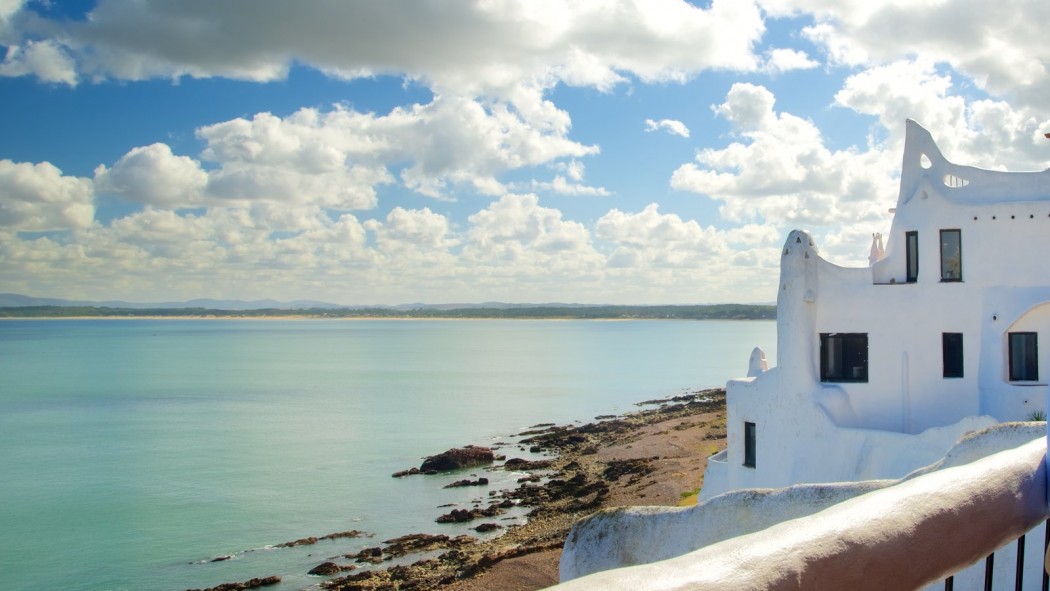
The neighborhood around Casapueblo is chosen by families who value the tranquility of the wildest and most spacious beaches in the area.
This season, the McCarthys chose a beach just past Punta Ballena to enjoy the summer. They came here on the advice of a sister-in-law and have made it their own ever since.
With a two-and-a-half-year-old son and another on the way, they say they like it because the beach is very large, there are few people, the kids can be watched from a distance, they have room to run, and the water is calm. They have already managed to invite family and friends from school, so Quinto does not play alone. Far from the noise and the brand-sponsored beach bars, the area that goes from Laguna del Diario to Tío Tom, passing through Punta Ballena and Solanas, is once again chosen by many Argentines looking for quiet and discreet family vacations.
Here, the lots tend to be more spacious, the houses are larger, everything is done by car, and to put your feet in the sea, you have to walk a long way along the sand. Considerably longer if you're looking to immerse yourself completely. "We always rent for 15 days at the port, but maybe next year we could rent directly in this area. The houses are bigger, and I imagine they're different numbers, but it's worth considering. You think it's far, but it's not, because you're going against the flow of traffic," says Augusto, 35.
The area bordering Laguna del Diario is divided between a part with more residences and frequented by Uruguayans (from 39 to 25, Pinares and Las Delicias beaches) and another with larger lots and less construction (stops 40 to 43). On the way to Montevideo, there is then a very green area, without construction and without a view of the sea, before climbing the ridge of Punta Ballena, with Las Grutas, Casapueblo and Solanas on the left.
“There are two Punta del Este: La Mansa and La Barra. La Mansa is peace, sunsets. La Barra is noise, entertainment, and small properties. José Ignacio may be very nice, but it doesn't have a hospital or airport nearby. I'm not a fan of it, and I don't understand the prices. They're two different vacations: inside and out. I don't come here to show off. I come here to have a good time. My house captivates me,” confesses Jorge Cohen, an Argentine who works in finance and has chosen this part of the resort for summer vacations for 45 years. His five children rest and his 12 grandchildren play on his one-block lot, overlooking the lagoon, with tennis and paddle courts, and a pool. “Almost 13,” he corrects.
Cohen says that between stops 40 and 43 the lands are beginning to be divided up and there is more movement, especially because Uruguayans are starting to build houses. There are also some new buildings and projects that have sparked controversy, such as the tower complex that they plan to build around Poseidón, the white house built by the Uruguayan architect Flores Flores and which has become an emblem of the postcards of the Este.
The best-known beach has always been Portezuelo, baptized Solanas by the Argentines after the Solana del Mar hotel, which was built by the Catalan Antonio Bonet in 1946. With six rooms for between $385 and $410 a night, this wooden architectural refuge still functions as such, although it also fulfills the role of an elegant inn. This has always been one of the favorite beaches for families because it is wide, the water is generally calm and there are at least 30 meters of foot space and a sea that does not pull in before reaching deeper parts.
If you walk along the beach, you then come to the real Solanas (from the road it is turning at the roundabout, at the height of Ancap) and Bonifacio (also known as Playa Plomo by the locals), where Olaf has set up, a wooden beach bar with good drinks and dishes that works day and night, and with jazz in the evenings facing the sea. Then there is Tío Tom, with locals and tourists, and Chihuahua, with a well-defined profile because it is a nudist beach, although many people also go with clothes to have a drink at the beach bar.
Out of the loop
Leandro Quiroga was 18 years old when he founded Medio y Medio, a Punta Ballena classic that every summer, starting at the end of December and throughout January and February, offers 40 shows in 60 days. The festival seeks to showcase the best of popular music from Uruguay, Argentina and Brazil, and this musical haven in the east has been operating for 23 years. This season he innovated with the franchise of an Argentine brewery, 1516, the first space that stays open until 4 in the morning.
“The clientele here is family-oriented and business-oriented, with owners and tenants. There's been a lot of construction in recent years, particularly in small, premium neighborhoods, and that's changed the profile. The purchasing power, in general, is high. Originally, it was only Argentinian, although now it's divided, and more and more foreigners are coming. There's no press or paparazzi here. Many people stay in La Barra and go out in this area because it's off the beaten path in terms of exposure. It's more discreet. The developments are all high-end, but there's no ultra-exclusivity. It's a different kind of high-profile: more business-oriented and less show-stopping,” Quiroga analyzes.
This businessman says that Punta Ballena has always had a high-flying cultural profile: the area was created by Antonio Lussich, a Croatian entrepreneur who acquired 1000 hectares of dunes and planted a forest to protect himself from the wind. As he had a maritime rescue company, he brought species from all over the world back from his travels. This is how the Lussich Arboretum was born, which can be visited today and is a very good program. Lussich also wrote and is the author of Tres Gauchos Orientales, a work that he showed to José Hernández, who was a good friend. Hernández would later publish Martín Fierro. Years later the land was acquired by an Argentine group that commissioned the urban project to the Catalan Antonio Bonet. The squares are all shaped like anchors, between the lots there are paths with direct access to the beach, and there is an area exclusively designed for mansions. In this development almost all the license plates are Argentine. Uruguayans know little or nothing about it.
To watch the sunset, in addition to the already well-known point past Casapueblo, there is Manantiales Point, which did not change its name for this second location and was installed in front of Marina del Este, the first complex built on the back of the Whale. On that road you can also see the new projects, all built facing the Point. Before, the trend was to look towards the bay of Punta Ballena, from where you can see the sunset, but those spaces are so exhausted that construction is spreading out towards empty land. The back of the Whale, which used to be green, is now also completely taken over by new houses.
Every Saturday in the summer, for the past two years, local artists have opened their studios to the public for an evening of art. Among them, Héctor and Serrana del Castillo, father and daughter who exhibit colorful paintings with drawings inspired by the forest and birds in the area. Located on Murmullos del Mar street, you can also see the silk scarves that Serrana creates under the name Gauderia. They are joined by La Caja, an art and gastronomy space; Dalarna, which in addition to exhibiting art is a nursery and is located in Chihuahua; and Olaf, which in addition to live jazz offers an exhibition of mosaics by Juana Guaraglia and guest artists. Another program worth highlighting in this area is Route 12. It begins in Punta Ballena, at the height of the Hotel Las Cumbres, and is considered a panoramic route. During the tour you can visit two wineries: the Uruguayan Alto de La Ballena and the Brazilian Viña Edén.
Last Friday, the Whalers' Club hosted the Flower Festival, the only celebration of the year that brings together several of the 210 members. Founded in 1965 and designed by Carlos Paéz Vilaró, this social, sports, and family club brings together the vast majority of the area's property owners. Argentines used to represent 80%, but today that number has dropped to 60%. "The identity of this area is very family-oriented. This is a place where, when the season is crazy, you find peace. And not because there aren't any people. There are, but the space is large and very peaceful," says Argentine María Eugenia Timossi as she puts the finishing touches to the dining room. Open to the public, the restaurant is worth a try: the menu of fresh fish, seafood, and sushi is complemented by an unparalleled view of the saltwater pool, followed almost seamlessly by the immensity of the sea.
By: Nathalie Kantt
