

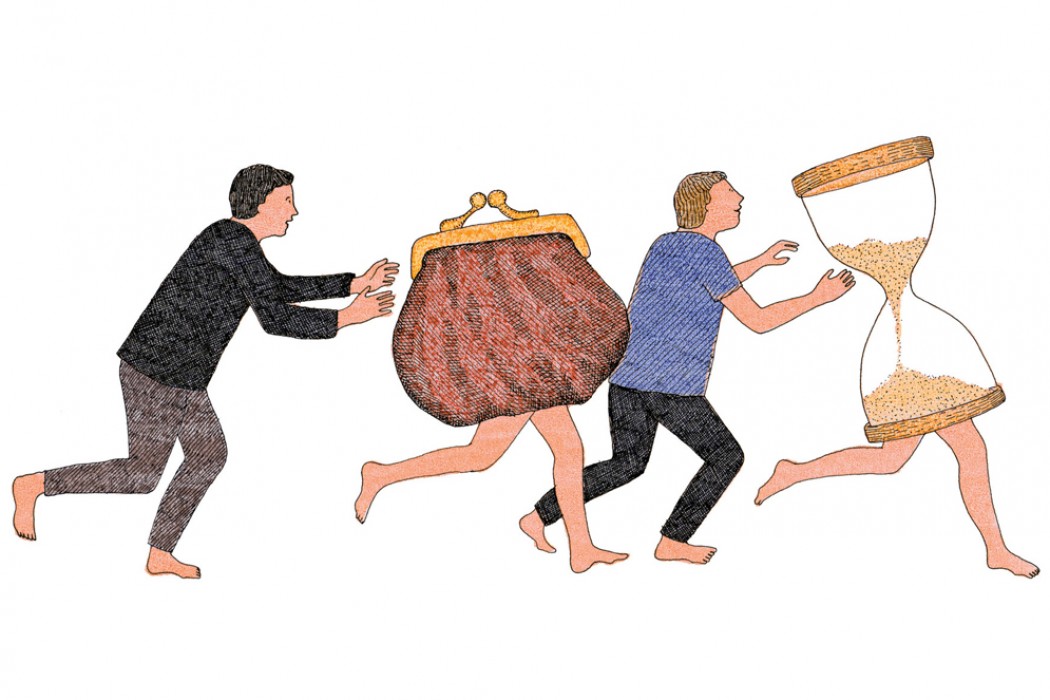
If you were given the choice between more time or more money, which would you choose? If it were a beach vacation, you'd probably pay more for a direct flight to get a couple more hours of sand under your feet. On the other hand, you might take a higher-paying job even if it meant staying in the office for much longer. One of us, Professor Hershfield, was recently faced with that choice: He was invited to give a weekend seminar in another state, but he had a baby at home, just 12 weeks old. The paycheck he would receive would cover the cost of caring for her, but the job meant he would miss out on two days of wonder, joy, and bonding with her.
The value of money was easy to quantify, but it was harder to put a value on the amount of time he would be away from his family. He determined that he had only 222 weekends left before the baby left for kindergarten, at which point quality family time would give way to carpooling to friends’ houses.
What would make you happier: money or time? As part of a research project, we asked this question to more than 4000 Americans with and without children of various ages, income levels, occupations, and marital status. We published an article in the journal Social Psychological and Personality Science explaining that most people value money more than time. Of the 64 people we asked the question in five surveys, 4415 percent chose money.
Is money the right choice? We had to ask our respondents to tell us their level of happiness and life satisfaction. We found that people who chose time were statistically happier and more satisfied with life than people who chose money. So money might not be the right choice.
However, this result may simply show that people who choose money are more limited in finances and therefore less happy. To test this, we also asked respondents to tell us their annual household income and the number of hours they work per week (to measure how much time they have).
We found that even when we equally controlled for the amount of free time and money (as well as age, gender, marital status, parenthood, and value placed on material possessions), people who chose time over money were still happier. So if you had two people who were otherwise equal, the one who agreed that time was more important than money would be happier than the one who only chose money.
Our research does not claim that having more of one or another resource is better or worse for happiness. Other research looking at the relationship between wealth and happiness suggests that, for example, higher income is positively related to happiness up to a certain point ($75.000 in the US) and life satisfaction continues to increase as income increases.
However, our research shows that the value people place on these resources does predict happiness. Participants in our studies who chose time as more important than money evaluated these resources differently and had different intentions to spend the money or time they gained.
Unlike those who chose money, who were more likely to obsess about not having enough, people who chose time focused more on what to do and planned to “spend” their time on things they wanted rather than what they needed (e.g., pursuing a hobby rather than doing chores) and spending time with other people — both of which are associated with higher levels of happiness.
If, when you answered our open-ended question, you chose money, don’t worry. We present this choice as a reflection of a stable preference, but there is room for change. When we asked a group of participants to choose between the two a year later, some (25 percent) changed their minds. Also, when we conducted an experiment in which we asked people to focus on the value of time (by naming reasons why they wanted more time), they felt happier than those who were asked to focus on the value of money (who also mentioned reasons why they wanted more money).
In our quest for happiness, we are continually faced with decisions big and small that force us to weigh time and money. Of course, sometimes there is no choice: we have to earn that extra money in order to make ends meet. However, when the choice of more time over more money is something we can choose (despite the widespread tendency to do otherwise), this is a good sign that we will find the happiness we seek.
So, did Professor Hershfield go on a trip and earn a little extra money to take care of his baby, or did he stay home to be with her? He already knew about our research, so he decided to stay home.
SOURCE: http://www.nytimes.com/
