

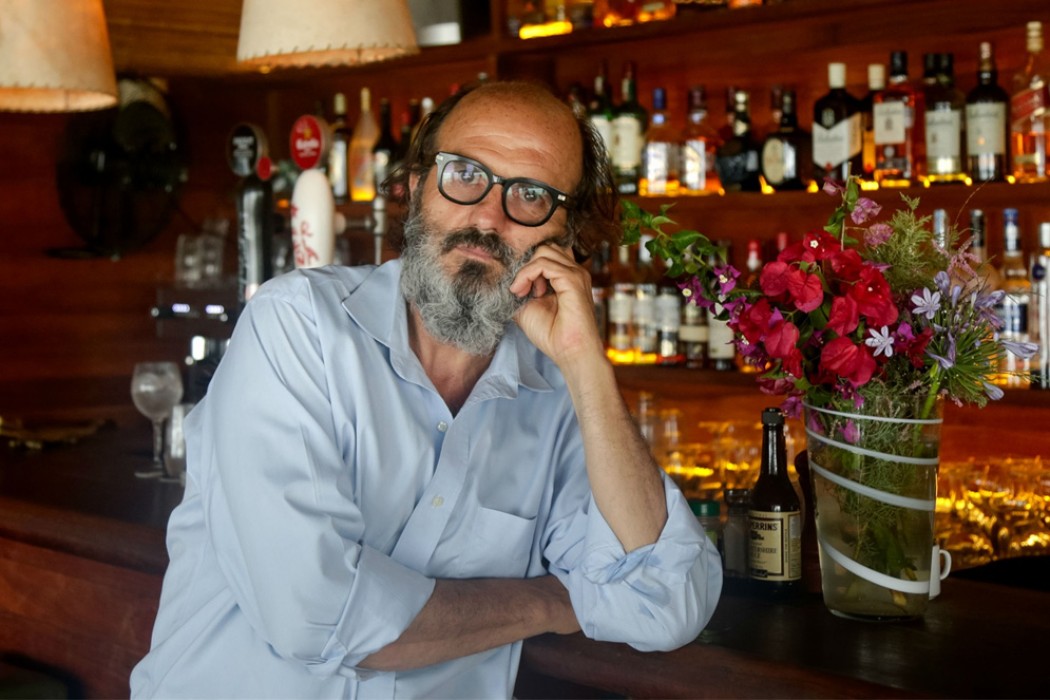
Of the gastronomic entrepreneur Martín Pittaluga, owner of the La Huella restaurant and inn, the most prestigious in Punta del Este, located in the exclusive resort of José Ignacio, it can be said, literally, that he is "on top of everything that happens in his establishment." Tall and electric, Pittaluga moves around checking that everything is in order. He sticks close to the army of waiters who serve the 300 diners who enjoy the food and atmosphere of the place every lunchtime and evening, which is frequented by celebrities from politics, sports, and entertainment.

A former councillor for the Frente Amplio, the businessman is very interested in the history and politics on both sides of the River Plate, which often leads the interview there. Pittaluga acknowledges that this season has been exceptional, but says that, rather than an explosion of tourism, he prefers sustained growth in the area that respects the care of nature. They say that the difficult thing is not to get there, but to stay there. How do you manage to keep La Huella at the top for 17 years? There is great teamwork here. We are three partners and a team of managers who are very operational, who are on the field, in action and not so much in the office. There is a lot of planning involved but it is realized on the field. And then there's the rest of the team, which is people who have been with us for a long time. The basis for success is having a good team, and a team that is not only technically good, but also committed to the place. They have grown up with us. The number of people working at La Huella is surprising. How many? Counting the people who collaborate with administration, production, laundry and maintenance, we have 200 people, who collaborate with the other two restaurants in the group, La Caracola and Santa Teresita. Is it a decision not to save on personnel? It's a whole topic. I have a radio show focused on jobs that are disappearing and robotization. Does it take so many people to operate? The trend in countries like France, which is a reference for us, the United States or Spain, is that the number of staff is decreasing and technology is advancing. We have a rapid cooling machine, a blast chiller, we bought it last year. Our working style is to try to incorporate technology, but always in a limited way. We have a kitchen with 40 people working. We have plenty of cutlery. The Footprint grew too big. It's not going to grow any more in cutlery. We are not interested in records. There is a lot we do. We host staff at La Juanita on a seasonal basis. We have 20% foreigners, almost all Argentines. You say that Punta del Este is overbuilt. Is there a chance that the same thing will happen in José Ignacio? We have an ordinance that is being adapted to avoid the destruction of the place, but understanding its development. The lighthouse 30 years ago is not the same as it is today. José Ignacio has changed, he is in fashion. Those who come to Uruguay come because they are looking for an orderly country, with nature that is still acceptable, uncontaminated, and with fantastic sand. Let's put aside what has already been done. Going forward, we have to strengthen the ordinance that already exists and negotiate with the mayor's office. The mayor will always be under pressure to be more flexible and to approve projects. What we have to do is renegotiate what can and cannot be done so that José Ignacio grows outwards, not inwards. Keep the hull as tidy as possible inside and organize traffic. There are five development projects on the beach line, but let's do it in a planned way, with sanitation works. Garbage collection has been excellent this year, the lifeguard huts have been a before and after in the aesthetics of the beach. A drink and a dish to recommend You were opposed to the construction of the bridge with Laguna Garzón. Now it's finished, how do you see it? I don't think it was necessary, but we achieved three points: converting the place into a protected area, converting the national route into a departmental one, so that trucks cannot circulate, and having the bridge built according to the design of architect Rafael Viñoli. In the end it was not finished as he wanted, with wood, with a shadow. This was pushed by (Argentine businessman Eduardo) Costantini. And I'll be honest with you, my kids bought it on the other side. They work here, they are young guys. This is going to have a sloooow growth. It will take 20, 30 years. Peru has become a beacon of world gastronomy, and now Buenos Aires is working in that direction. How do you see Uruguay? That's where our older brothers are teaching us something good, positive. It is a proposal from the City government that I think is very good. The government there is very active and has a vision of projection. I like it because they have a plan. The gastronomic movement in Buenos Aires (there is also one in other places, such as Córdoba, with El Papagayo) is impressive. The movement of 25-30 year old guys and girls who do kitchen-garage, creative guys who are on the spot working, with quality products and reasonable prices and spirit. It's impressive how many there are. Could you recommend a pair? I love Propper, of course, Big Dabbang. These are the initiators of this movement. That kitchen-garage, which is in non-traditional neighborhoods, generates a different movement, an originality and an authenticity that Buenos Aires did not have. Uruguay is sucking this up. How is Cinco working in Miami? It's working very well. It was a very difficult bet. It operates on the fifth floor of a cement building. It is the antithesis of La Huella aesthetically. He is walking. It is successful. In order for you to be able to say that a restaurant is working, you have to wait two years. There is a lot of supply in Miami. What remains is the constant work, the team work, a great sacrifice must be made. We spend a lot of time of our lives here. It is a restaurant where people want to come and have a good time. You have to be very present. People don't just come to La Huella to eat, they come to have a good time. Vanesa González, the head chef, has been here for 16 years and her mother worked with us. Do you make a difference when a celebrity comes? Whoever comes, Tinelli, Sarkany, Pampita (a wonderful person, educated, careful), Pocho Lavezzi, who is a horseman, here the finesse and elegance are experienced in a different way, with the treatment of the groom. We try to keep them in places where they don't have their photos taken, there is no VIP. What we do know is that if you come with a screaming baby, we put him in another place where there are other screaming babies. And if you want to celebrate your anniversary, we'll have a place. There are places for different situations. Argentines and Uruguayans How do you see the relationship between Argentines and Uruguayans in Punta del Este? Uruguayans complain about bad manners, but we Argentines love them. I think that we should specify a little more in the porteño. For Uruguayans, the person from Buenos Aires is not the same as the person from Entre Ríos, Córdoba or Santa Fe, who we consider more Artigas-like. I live in Buenos Aires and my wife is from Buenos Aires. But a person from Entre Ríos is a Uruguayan. It has the same values. I think it's a relationship that runs in different directions. Historically it was born with the rivalry of the ports, we are like first cousins, smaller. Borges talks a lot about these differences, because his mother is Uruguayan. We are the same but different. But add to that what happens in Punta del Este, which is the rivalry of the vacationers. The Argentines invaded us, they took us over in the 50s. It is like that. Punta del Este is a summer resort where there are more Argentines than Uruguayans and that creates a problem. The football rivalry is very strong. Some Uruguayans celebrated the German goal in the World Cup final in Brazil. But do you see bad manners and arrogance in the people of Buenos Aires? Not anymore. It's a different way of driving. They have a strong burden when asking for things. But above all the upper-class people from Buenos Aires who come here. I don't experience that here in the restaurant, I don't see it, but it exists. The Uruguayan doesn't talk much, he doesn't like to tell what he has. In part, Uruguayans have an inferiority complex, it's a long topic. But if it's a beach question, I would say yes, there is a rivalry, a feud, nonsense. Macri, Cristina and Uruguay It would seem that Punta del Este has done much better since Macri came to power. It also seems that Uruguayans generally do not like the Kirchners very much. How do you see this political and economic change? The fact that Macri is in power has benefited Uruguay in every aspect, beyond ideology. What Néstor and Cristina did by allowing the bridges to be blocked was very damaging to tourism and to Uruguay. Being ideological relatives of the Broad Front, from the start there was a very strong enmity and confrontation between Tabaré and Kirchner. Then, when the middle and upper middle class in Argentina have a more prosperous horizon, obviously the situation in Uruguay, in tourism and other issues, improves. When we have to sign a free trade agreement with Europe, the story is different. Even the Uruguayan left did not have much sympathy for the Kirchners. Uruguay, from left to right, is a country that is not authoritarian, it is democratic, it respects the powers and that is very important here. There is no politician here who walks around the streets and has problems. The other day the Minister of Economy, Astori, went to drink mate on the beach with his wife and that is normal. Don't you notice that the Uruguayan left is more rational than the Argentine one? Of course yes. The Uruguayan left, the Frente Amplio, has been on a progressive path of distribution, of improving the conditions of Uruguayans over the last 12 years and there are very clear results in sight. The country is divided, but there is no rift in Uruguay. In Argentina, for the Kirchnerist, the Macrista is a devil and vice versa. You now have the system of selling marijuana in pharmacies. What do you think? It is an excellent law. We had some difficulties with the issue of payment to banks on the part of the United States. It's now fixed. Nowadays, marijuana can be bought in pharmacies, it can be grown by yourself, and there are cannabis clubs. All three are implemented and working. It's a success. The real cancer of Uruguayan youth is crack paste. Marijuana is much healthier than alcohol. In my opinion, it is much less harmful. Do you make a difference when a celebrity comes? Whoever comes, Tinelli, Sarkany, Pampita (a wonderful person, educated, careful), Pocho Lavezzi, who is a horseman, here the finesse and elegance are experienced in a different way, with the treatment of the groom. We try to keep them in places where they don't have their photos taken, there is no VIP. What we do know is that if you come with a screaming baby, we put him in another place where there are other screaming babies. And if you want to celebrate your anniversary, we'll have a place. There are places for different situations. Argentines and Uruguayans How do you see the relationship between Argentines and Uruguayans in Punta del Este? Uruguayans complain about bad manners, but we Argentines love them. I think that we should specify a little more in the porteño. For Uruguayans, the person from Buenos Aires is not the same as the person from Entre Ríos, Córdoba or Santa Fe, who we consider more Artigas-like. I live in Buenos Aires and my wife is from Buenos Aires. But a person from Entre Ríos is a Uruguayan. It has the same values. I think it's a relationship that runs in different directions. Historically it was born with the rivalry of the ports, we are like first cousins, smaller. Borges talks a lot about these differences, because his mother is Uruguayan. We are the same but different. But add to that what happens in Punta del Este, which is the rivalry of the vacationers. The Argentines invaded us, they took us over in the 50s. It is like that. Punta del Este is a summer resort where there are more Argentines than Uruguayans and that creates a problem. The football rivalry is very strong. Some Uruguayans celebrated the German goal in the World Cup final in Brazil. But do you see bad manners and arrogance in the people of Buenos Aires? Not anymore. It's a different way of driving. They have a strong burden when asking for things. But above all the upper-class people from Buenos Aires who come here. I don't experience that here in the restaurant, I don't see it, but it exists. The Uruguayan doesn't talk much, he doesn't like to tell what he has. In part, Uruguayans have an inferiority complex, it's a long topic. But if it's a beach question, I would say yes, there is a rivalry, a feud, nonsense. Macri, Cristina and Uruguay It would seem that Punta del Este has done much better since Macri came to power. It also seems that Uruguayans generally do not like the Kirchners very much. How do you see this political and economic change? The fact that Macri is in power has benefited Uruguay in every aspect, beyond ideology. What Néstor and Cristina did by allowing the bridges to be blocked was very damaging to tourism and to Uruguay. Being ideological relatives of the Broad Front, from the start there was a very strong enmity and confrontation between Tabaré and Kirchner. Then, when the middle and upper middle class in Argentina have a more prosperous horizon, obviously the situation in Uruguay, in tourism and other issues, improves. When we have to sign a free trade agreement with Europe, the story is different. Even the Uruguayan left did not have much sympathy for the Kirchners. Uruguay, from left to right, is a country that is not authoritarian, it is democratic, it respects the powers and that is very important here. There is no politician here who walks around the streets and has problems. The other day the Minister of Economy, Astori, went to drink mate on the beach with his wife and that is normal. Don't you notice that the Uruguayan left is more rational than the Argentine one? Of course yes. The Uruguayan left, the Frente Amplio, has been on a progressive path of distribution, of improving the conditions of Uruguayans over the last 12 years and there are very clear results in sight. The country is divided, but there is no rift in Uruguay. In Argentina, for the Kirchnerist, the Macrista is a devil and vice versa. You now have the system of selling marijuana in pharmacies. What do you think? It is an excellent law. We had some difficulties with the issue of payment to banks on the part of the United States. It's now fixed. Nowadays, marijuana can be bought in pharmacies, it can be grown by yourself, and there are cannabis clubs. All three are implemented and working. It's a success. The real cancer of Uruguayan youth is crack paste. Marijuana is much healthier than alcohol. In my opinion, it is much less harmful.
LANATION
